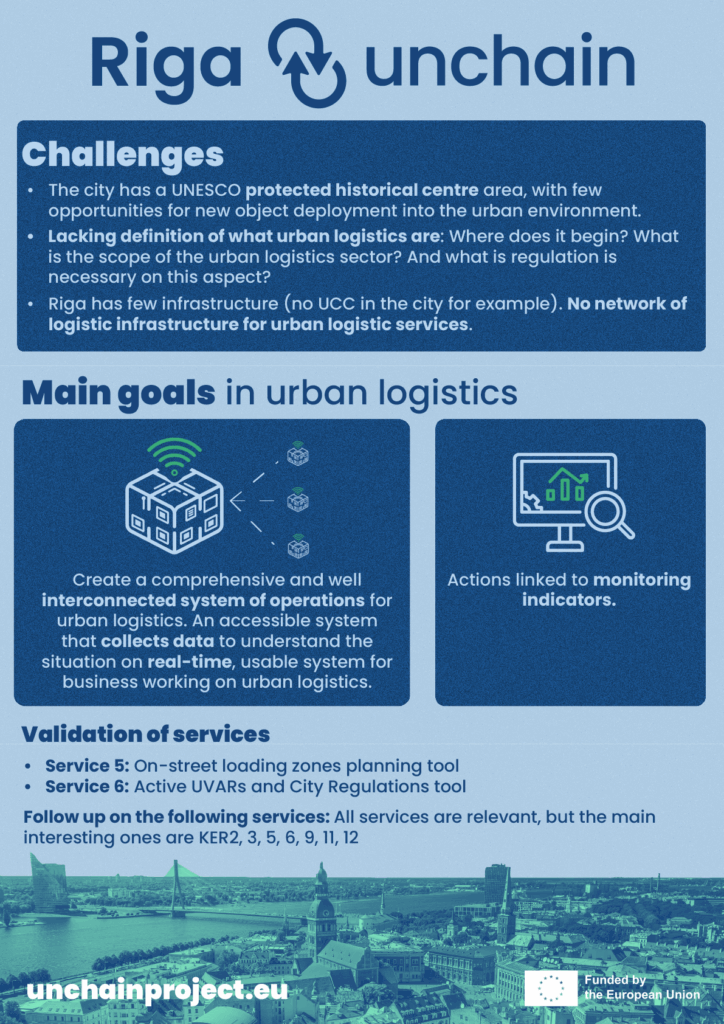
City baseline card: Riga

Riga’s city baseline card discusses its unique challenges in integrating urban logistics within its UNESCO-protected historic city center. It highlights infrastructure gaps, regulatory uncertainties, and the absence of a defined urban logistics framework.
Riga’s case highlights the difficulty of advancing sustainable urban logistics in a city with both infrastructural gaps and heritage-related restrictions. The absence of a defined logistics framework, what counts as “urban logistics,” its boundaries, and regulatory scope, makes planning fragmented. Moreover, the lack of a logistics infrastructure network (e.g., no urban consolidation centre) limits the ability to test and scale new delivery models.
Challenges faced
- The UNESCO-protected historical city centre restricts the ability to introduce new facilities or infrastructure.
- Few existing logistics assets: Riga has no UCC and limited logistics service infrastructure.
- Lack of clear definitions and regulations for the scope of urban logistics, making it difficult to design coherent policies.
Riga’s ambitions
Riga aims to create a comprehensive and interconnected urban logistics system that can:
- Collect and use real-time data to monitor flows and understand the situation on the ground.
- Provide a usable platform for businesses engaged in last-mile logistics.
- Link actions directly to monitoring indicators to support data-driven policymaking.
Tools and approaches considered
Follow-up interest in multiple knowledge elements (KER2, 3, 5, 6, 9, 11, 12), indicating a strong focus on strategic planning and regulatory innovation.
Service 5: On-street loading zones planning tool.
Service 6: Active UVARs and City Regulations tool.
Downloads