City baseline card: Prague

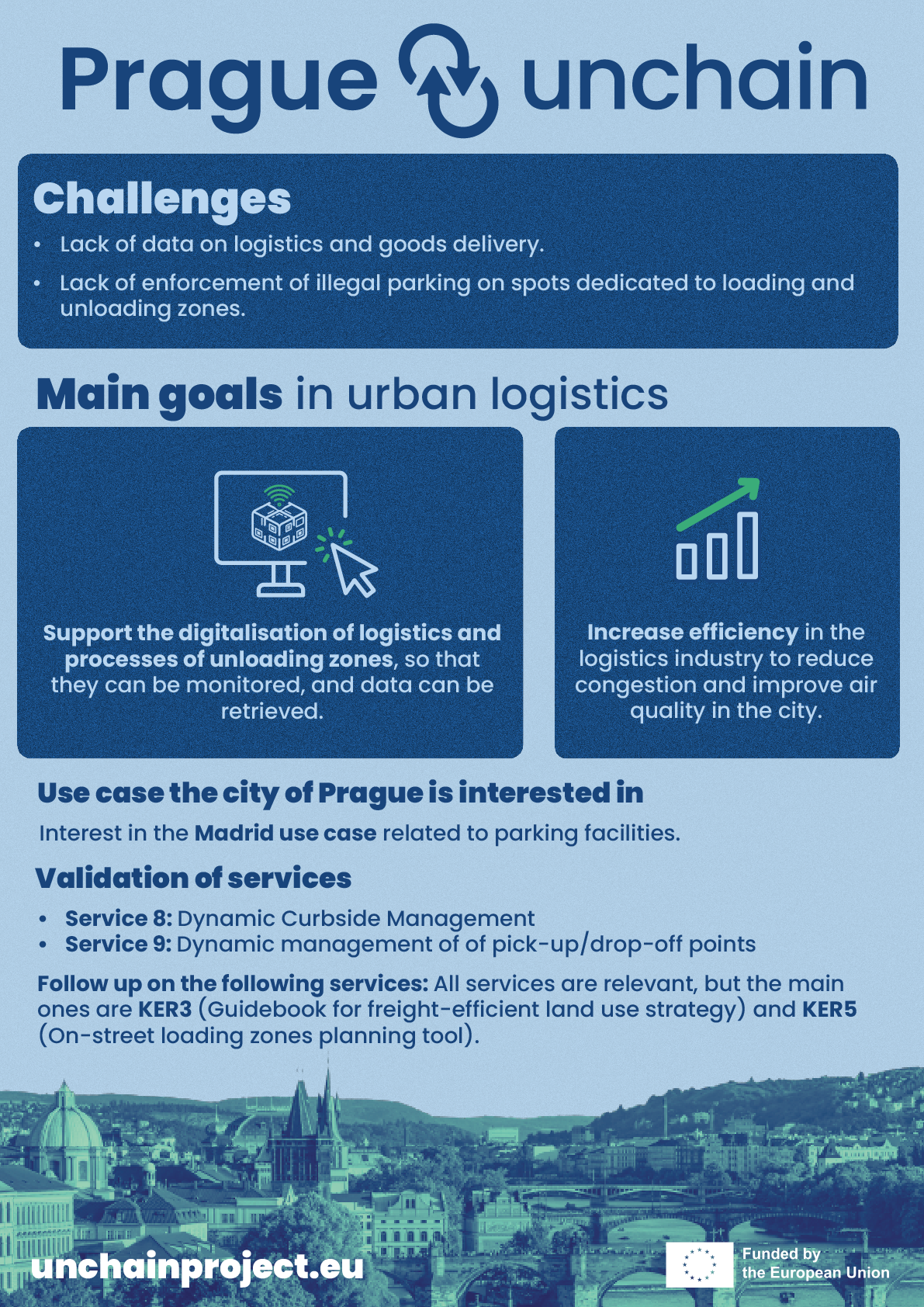
Prague’s city baseline card outlines the city’s challenges in managing urban logistics within a dense and growing metropolitan context. The document emphasises insufficient data on logistics flows, a lack of enforcement around loading and unloading zones, and the resulting inefficiencies in goods distribution. These shortcomings exacerbate congestion and air quality issues in the city centre.
Prague’s case illustrates how urban logistics can be constrained by fragmented information and weak regulation. Without reliable data on deliveries and vehicle movements, it is difficult to plan effectively or enforce measures against illegal parking. At the same time, the city recognises the potential of digitalisation and advanced curbside management tools to make logistics more efficient and sustainable.
Challenges faced
- Lack of reliable data on logistics activity and goods deliveries.
- Weak enforcement of regulations on loading and unloading zones, leading to widespread illegal parking.
- Growing congestion and associated air quality concerns.
Prague’s ambitions
Prague aims to modernise its logistics management by:
- Supporting the digitalisation of logistics processes in loading and unloading zones.
- Increasing efficiency in the logistics sector, reducing congestion, and improving air quality.
- Learning from European peers, particularly Madrid, in applying parking and facility management solutions to the Prague context.
Tools and approaches considered
- KER5: On-street loading zones planning tool.
Validation of specific services:
- Service 8: Dynamic Curbside Management.
- Service 9: Dynamic management of pick-up and drop-off points.
Follow-up interest in knowledge elements:
- KER3: Guidebook for freight-efficient land use strategy.
Downloads